


Hermes Agent Just Became the Fastest-Growing AI Agent in GitHub History
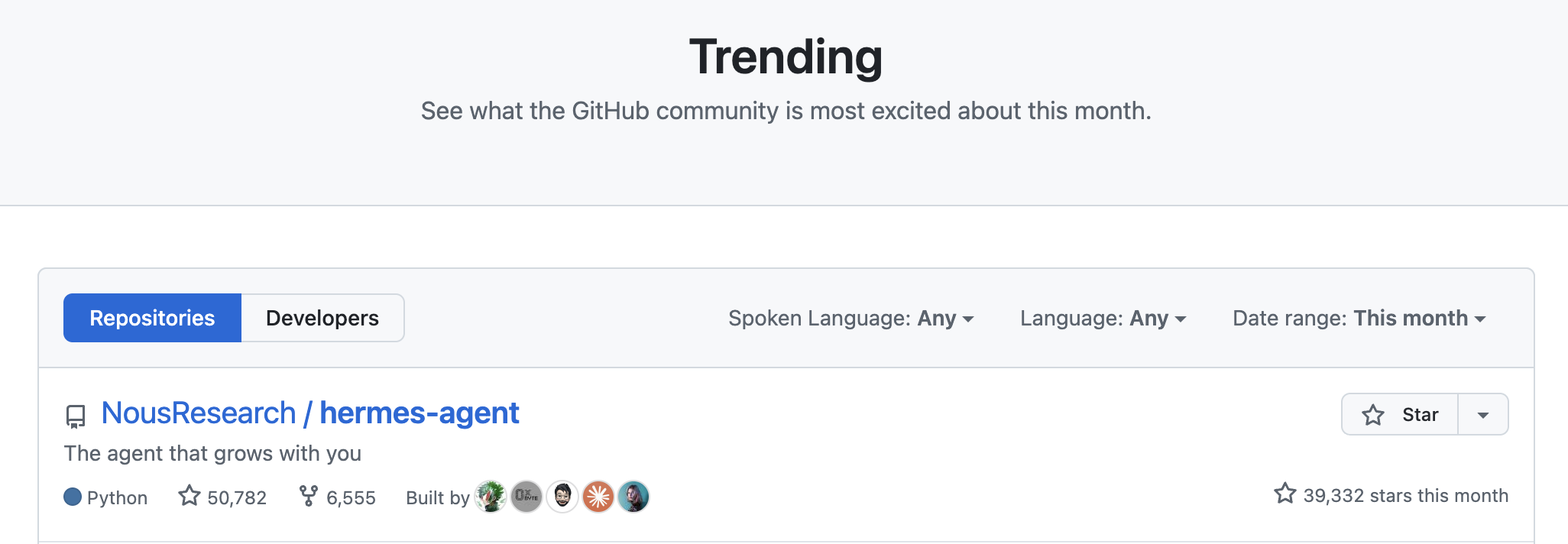
50,782 stars. 366 contributors. 46 days. Here's what's driving the numbers and why it matters.


Since first publishing Hermes Agent vs OpenClaw: Why Developers Are Switching on March 18th Hermes has grown exponentially in usage and popularity. Hermes Agent is currently the most trending project on GitHub, with over 50,782 stars and 366 contributors. For context: OpenClaw went from zero to 40,000 stars in 61 days. Hermes did it in 46.
Nous Research also confirmed that Hermes is officially their fastest-growing project ever.
Hermes Agent is officially our fastest-growing project ever!
— Nous Research (@NousResearch) February 27, 2026
A huge thank you to everyone who has been experimenting with it, shared the announcement, or took the time to make a contribution to the project. pic.twitter.com/LlbK2HftEw
So what actually makes it different?
Nous Research said it best "Hermes is an autonomous agent that lives on your server, remembers what it learns, and gets more capable the longer it runs." That's the simple version. The nerdy version or more precise version is: Hermes is the first serious productization of what researchers call "Harness Engineering", the idea that an agent needs five distinct layers to function well: an Instruction Layer, a Constraint Layer, a Feedback Layer, a Memory Layer, and an Orchestration Layer. With OpenClaw you need to manually write these layers yourself, you need to know what you're doing, and it takes time. With Hermes, all five run automatically. That's the big shift and it's the difference between a framework built for engineers and one built for everyone.
The Hermes Agent The Complete Guide written by HuaShu (花叔), put it clearly:
"OpenClaw gives you a configuration-as-behavior system, you write a SOUL.md, and it becomes what you want. Its memory system is capable (Daily Logs + MEMORY.md + semantic search) and its Skill ecosystem is massive, but Skills are primarily written and maintained by hand. Hermes has all five dimensions built in, and they run automatically."
Why Nous builds this way?
The speed and openness aren't accidental. Nous Research being an open source AI research lab means they have a few set of core principles which are that the user control comes first, the model is steerable, and you can adjust its behavior as needed, free from corporate content policies.
Jeffrey Quesnelle, one of Nous' co-founders, said during an X Space this week:
"We believe as a first class citizen running a model locally is something you also can do and we are never gonna go away from that since when we started it was all about that you should be able to own this whole tech stack yourself if you want to."
Listen to the full X space hosted by Robert Scoble here.
That philosophy is visible in how the project is run. The codebase is open source and written in Python, so developers can extend it without fighting the ecosystem. Teknium, another Nous Research co-founder and head of post-training, is visibly present in the community, responding to builds, asking what people want to see next, and shipping integrations fast.
This is what open source is supposed to look like. And 50,782 stars in 46 days suggests the community agrees.
Highly recommend you read HuaShu's (花叔) Complete Guide to Hermes Agent, it's the most thorough technical breakdown available right now.